
To put 20 Hz out at 85 dB from a pair of bookshelves with 13 cm woofers, the cones have to travel about 9 mm each way. Almost nothing on the market moves that far. Before you go looking at the room or the placement for the missing bass, it is worth checking whether the source side already set the ceiling. That ceiling can be worked out from cone size and driver count alone.
The short answer
In the bass, a speaker’s maximum SPL is governed by how much air the cones can move. Effective cone area times one-way excursion gives volume displacement, and that is what caps the level. Hold the level constant and drop an octave, and the volume displacement you need goes up by a factor of four (+12 dB worth). That is why the low end runs out first. The inputs are cone size and driver count. Xmax, which your spec sheet almost certainly does not list, is not one of them.
Volume, not area, sets the ceiling
Volume displacement is the amount of air a cone shoves out of the way in one stroke. It is the effective cone area (the part inside the surround that actually pushes air) times the one-way excursion, in cm³.
Down low, a speaker is less making a sound than pumping air back and forth. The displacement a given level demands goes as the inverse square of frequency:
SPL_max(f) = 20·log10(Vd) + 40·log10(f) + 108.5 [half space, 1 m, sine rms, Vd in m³]Solve it the other way and the target level gives you the displacement it costs:
Vd_req(f) = 10^((SPL_target − 40·log10(f) − 108.5) / 20)
x_req(f)  = Vd_req(f) / Sd_total
More area or more travel, it makes no difference which: the product is what counts. One 20 cm driver and a bit over two 13 cm drivers land in the same place for exactly that reason.
Every octave down costs four times as much
The whole story is in 40·log10(f). Halve the frequency and you lose 40·log10(2) = 12.0 dB, so holding the level takes four times the displacement.
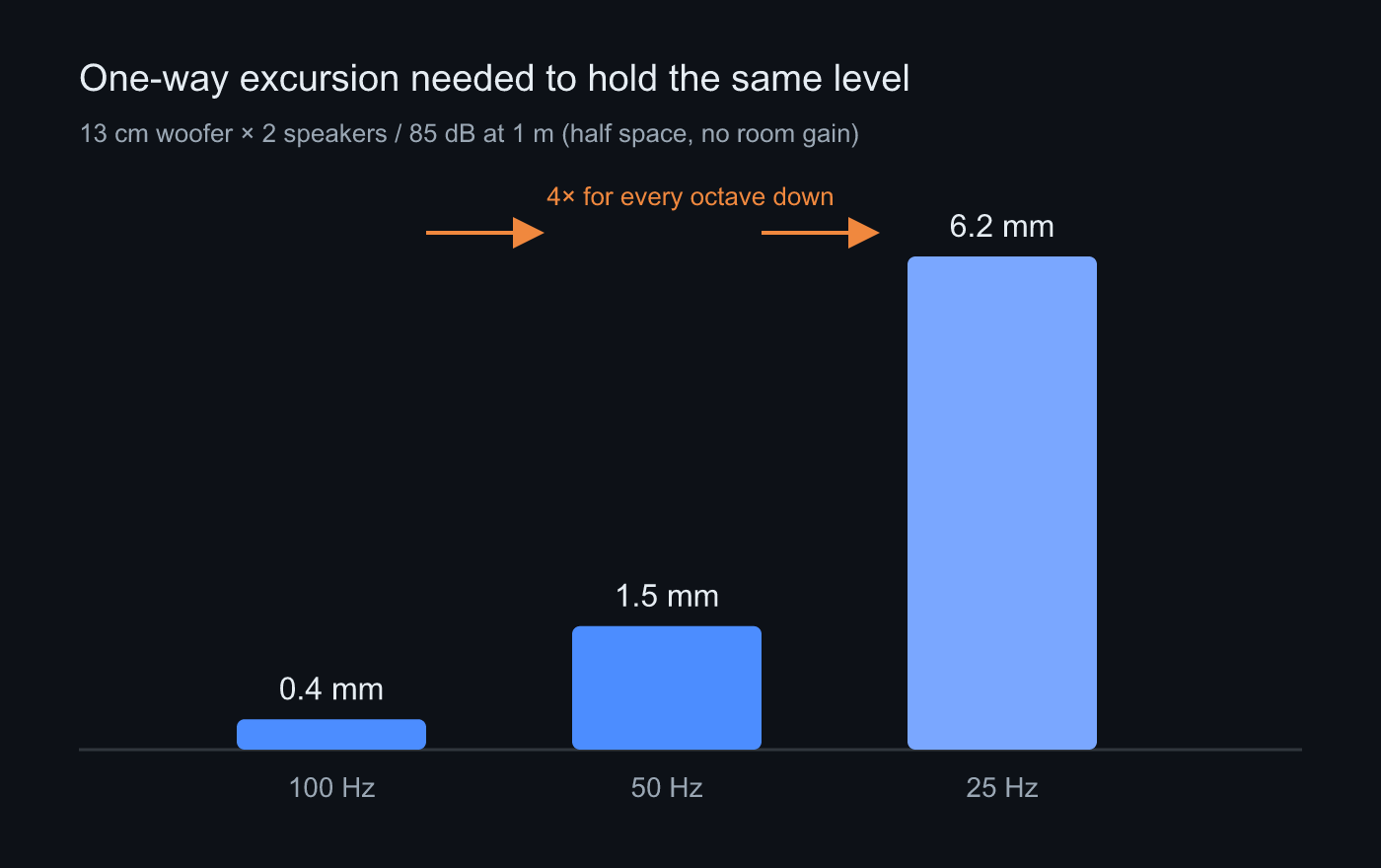 One-way excursion needed to hold 85 dB from two 13 cm woofers. 0.4 mm does it at 100 Hz; 25 Hz asks for 6.2 mm
0.4 mm at 100 Hz becomes 1.5 mm at 50 Hz and 6.2 mm at 25 Hz. That is what “no bass” usually is. Not the amplifier, not break-in. If a bookshelf woofer can move 2 to 3 mm one way, its realistic floor sits somewhere around 40 Hz.
Incidentally, this is also why bass drivers look the way they do. Deep travel needs a tall surround, a compliant spider and a frame stiff enough to hold both. The appearance is a consequence.
The awkward part is that a factor of four is not a gap you close by trying harder. It is not ten hertz of effort, it is an octave of brute force. Asking for 32 Hz asks for four times what 64 Hz asked for. Miss that and the temptation is to EQ the bottom up, which is the fastest route to bottoming a driver out.
Required excursion by cone size
One-way excursion needed for 85 dB (sine) at 1 m, from two cabinets with one woofer each. Effective diameter typically runs 0.75 to 0.85 of nominal, so these are bands rather than single numbers.
| Nominal size | 20 Hz | 40 Hz | 63 Hz | 100 Hz |
|---|---|---|---|---|
| 10 cm | 14.7–18.9 mm | 3.7–4.7 mm | 1.5–1.9 mm | 0.6–0.8 mm |
| 13 cm | 8.8–10.6 mm | 2.2–2.7 mm | 0.9–1.1 mm | 0.4 mm |
| 16 cm | 5.8–7.4 mm | 1.5–1.8 mm | 0.6–0.7 mm | 0.2–0.3 mm |
| 20 cm | 3.7–4.4 mm | 0.9–1.1 mm | 0.4 mm | 0.1–0.2 mm |
| 25 cm | 2.3–2.7 mm | 0.6–0.7 mm | 0.2–0.3 mm | 0.1 mm |
| 30 cm | 1.6–1.8 mm | 0.4–0.5 mm | 0.2 mm | 0.1 mm |
For reference, the effective cone areas behind those rows: 79–95 cm² for 13 cm, 189–227 cm² for 20 cm, 314–363 cm² for 25 cm, 452–531 cm² for 30 cm. Size is a diameter, so area follows the square. Going from 13 cm to 25 cm is 1.9× in diameter but about 3.8× in area.
Read the 20 Hz column down and you can see how unreasonable that frequency is. Even a 30 cm driver wants 1.6 mm; a 13 cm one wants over 9 mm. Subwoofers are 25 cm and up with absurdly long travel because that column is what they exist to satisfy.
Not asking for Xmax is what makes it usable
Calculations like this fall over for one reason: the numbers they need are not on the box. Effective cone area and Xmax (the linear one-way travel) are rarely published for consumer speakers.
Put them in an input field anyway and the user types a guess, and the calculator answers with a confident lie. “Your speaker reaches 103 dB down to 38 Hz”, built on an assumption nobody checked.
So do not solve it forwards. Turn the question around.
Not “how loud can this speaker go” but “how loud do I want it, and how far does the cone have to move to get there”
That needs cone size and driver count, which you can measure with a ruler and count with your eyes. What comes back is one number, the required excursion, and the owner is perfectly able to conclude that a 13 cm driver is not moving 9 mm. The calculation withholds the verdict and hands over the number the verdict needs. The browser-based speaker output calculator works the same way.
If you do know Xmax, the forward direction is there too. Two 20 cm woofers with 5 mm of one-way travel reach roughly 98–100 dB at 40 Hz, 106–108 dB at 63 Hz, and 86–88 dB at 20 Hz. Though people who have that number usually already know the answer.
What this leaves out
Displacement is the only limit here. Real speakers run out sooner.
Below a vented box’s port tuning is the first thing to bite. Under the port resonance the air stops loading the cone, and the same input swings it much further. Where a sealed box just rolls off, a vented one lets the cone flail. The table is optimistic in that region.
Port air noise is next. Above roughly 17 m/s of port velocity, compression and turbulence start becoming audible, and 25 m/s is the practical wall.
Heat shows up on sustained material. A hot voice coil has higher resistance, so the same input produces 2 to 3 dB less output. That is usually why the first measurement and the one five minutes later disagree.
Crest factor is the most frequent misread. The formula is a continuous sine level, while music has 12 to 20 dB between its average and its peaks. “I listen at 85 dB average” means putting 97 to 105 dB into the calculation. Entering the average and concluding there is plenty of headroom is the classic mistake.
And room gain is not in it. This is a half-space figure at 1 m. Your room may lift the bottom end by several dB, or drop it if your chair sits in a null. Room behaviour is something you measure and add, not something you assume.
Checking your own speakers
- Fix the target and the distance. Treat it as a sine level at 1 m. Music averaging 85 dB means calculating for 97 to 105 dB.
- Count and measure. Nominal size of the bass drivers, how many per cabinet, how many cabinets. A measured cone diameter beats an estimate.
- Get the required excursion. Use the table or the calculator, at 40 Hz and 100 Hz. Two points show the trend.
- Compare with the driver. Around 2 to 3 mm one way for a bookshelf woofer, 10 mm and up for a dedicated subwoofer.
- Choose a lever if it falls short. Quieter, less bottom octave, or more cone area. There is no fourth option.
- Measure to check. One sweep in Sonir puts the real roll-off on screen.
The calculation and the measurement never match exactly. The way they differ is the useful part: once they do, the cabinet and then the room are the next suspects.
In short
- In the bass, the ceiling is effective cone area times one-way excursion, i.e. volume displacement
- Drop an octave at the same level and the displacement demand goes up 4× (+12 dB worth)
- Two 13 cm woofers at 1 m for 85 dB need 0.4 mm at 100 Hz, 2.2–2.7 mm at 40 Hz and 8.8–10.6 mm at 20 Hz
- Double the volume displacement for +6 dB; doubling driver count and doubling area are the same move
- Do not calculate with your average listening level. Add 12 to 20 dB of crest factor first
- Port unloading and air noise, heat, the amplifier and room gain are all outside this model
Frequently asked questions
Can I work out max SPL without knowing Xmax?
Yes, if you solve it backwards. Instead of asking how loud a speaker can go, ask how loud you want it and how far the cone has to travel. That only needs cone size and driver count. Once the required excursion is on the table, you can judge whether the driver moves that far.
I want music at 85 dB. What number goes into the calculation?
Something like 97 to 105 dB. The formula is a continuous sine level, and music sits 12 to 20 dB below its peaks on average. Entering the average level is the most common way to imagine headroom that is not there.
How much do I gain by using two subwoofers instead of one?
Twice the moving cone is twice the displacement, so +6 dB. Doubling the count can beat going one size up, and effective area lets you compare them directly. Note that adding subs to even out room modes is a different discussion from adding them for level.
Does this include room gain?
No. It is a half-space figure at 1 m. A real room may add a few dB down low, or subtract if you are sitting in a null. That part gets measured.
My measurement came out lower than the calculation. Why?
Displacement is the only limit modelled. Cone unloading below port tuning, port air noise, power compression from heating (2 to 3 dB) and amplifier output are all absent. The measurement is the side that is right.
Related reading
- Measuring speaker frequency response with a smartphone: checking the calculated limit against reality
- Measuring room acoustics with a smartphone: the part this calculation deliberately leaves out
- Standing waves: why the bass misbehaves in a room: the same low end, from the room’s side
- Speaker or room? Separate them with two measurements: splitting source from room
- From frequency response to room EQ on a phone: know the ceiling before you boost toward it
Measure it with Sonir
Sonir turns a phone into an acoustic measurement and comparison tool. One sweep gives you a frequency response out of the impulse response, so the roll-off you just calculated shows up as an actual curve. Measure twice at two volumes and overlay them, and you can see the level where the speaker starts giving up. Everything, from the measurement to per-band analysis and overlaying measurements, is free.
Download on the App Store. Android is coming soon. See the features page for more.