
There was a -14 dB dip at 63 Hz. I was halfway to shopping for new speakers. Then I moved the mic to 50 cm, measured again, and the dip was gone.
The short answer
Measure the same speaker at two distances and overlay the curves. Where the listening-position pass (2-3 m) and the near-field pass (30-50 cm) diverge, you are looking at the room. Where they sit on top of each other, you are looking at the speaker. The boundary tends to land around 250-300 Hz, and the huge peaks and dips below it are the room until proven otherwise.
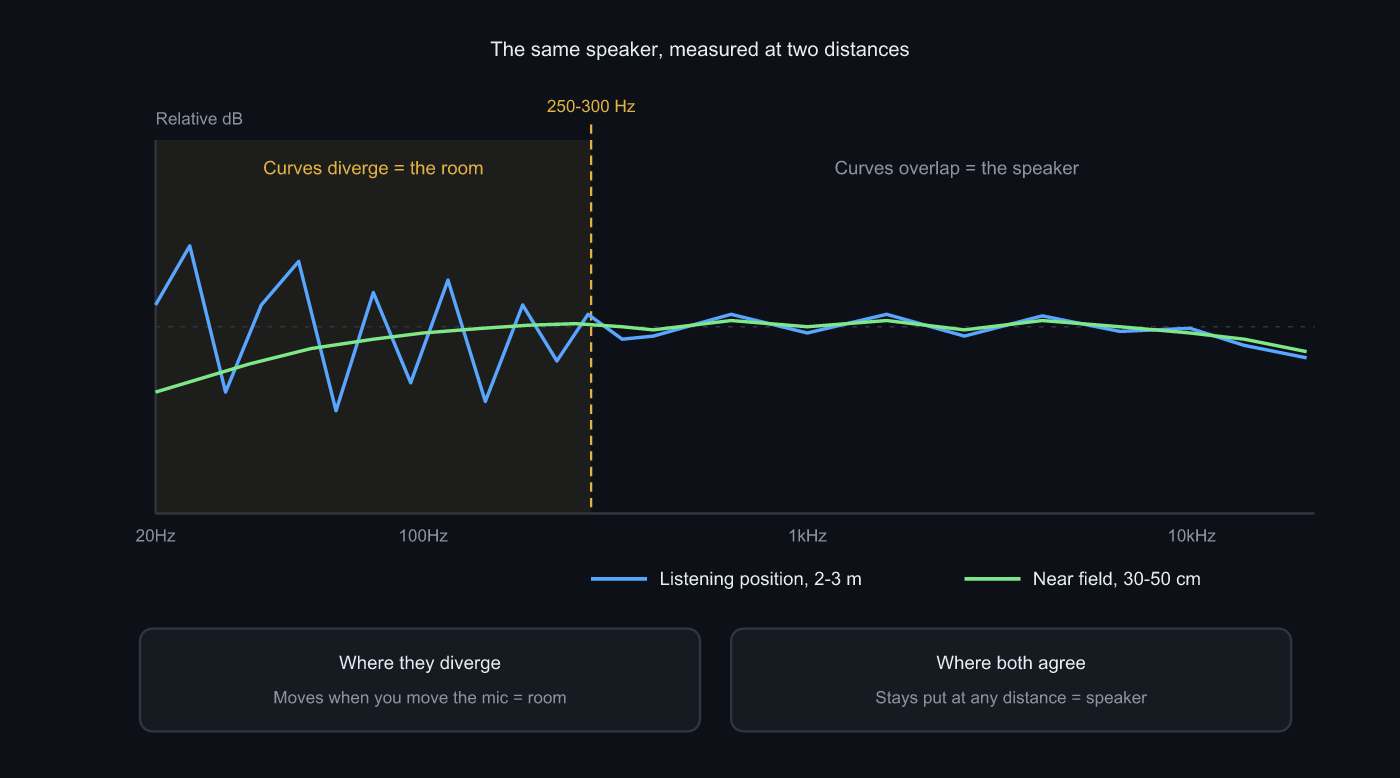 Where the two curves separate, the room dominates. Where they overlap, the speaker does. The boundary sits around 250-300 Hz
Why changing the distance separates them
What reaches the mic is direct sound from the speaker plus everything the room sends back a few milliseconds later. Those two react to distance in completely different ways.
Direct sound falls with the square of distance: halve the distance and it gains 6 dB. The reverberant part, having bounced around the room enough times to lose track of where it came from, sits at roughly the same level everywhere in the room. So the closer you get, the more the direct sound dominates. Going from 2-3 m to 30-50 cm is nothing more than a deliberate way to build a second curve with the room diluted.
Overlay those two, and any ripple that kept its shape survived a large change in how much room was present, which makes it the speaker’s. Bands that changed shape dramatically were dominated by the room. None of that information exists in a single curve, no matter how long you stare at it.
There is a limit, though, and it is the bass. At 63 Hz the wavelength is about 5.4 m, so shrinking a 2-3 m distance to 50 cm barely counts as a move on that scale. Standing waves fill the whole room, and you cannot outrun them by leaning in. Down there you change position instead: shift 30-50 cm in each direction, measure again, and treat only the dips that stay put as real.
The procedure
- First pass at the listening position, ear height, recording peaks at -6 to -12 dBFS
- Without touching the volume knob or any app setting, move the mic to 30-50 cm on the front axis
- Second pass with exactly the same sweep length. Up close, just confirm the peak is not pinned at 0 dBFS
- Overlay both in Compare measurements and split the range into diverging bands and overlapping bands
- If a suspicious bass dip survives, shift the listening position 30-50 cm and measure once more
You need a tripod. Two handheld passes add body reflections and positional scatter on top of the distance change, and then you no longer know what you compared. Keep the mic orientation identical across both passes too; where to put the microphone covers the basics.
Sonir’s Compare measurements overlays the two curves and puts the A−B difference in the foreground. It warns you when you overlay measurements whose calibration state or conditions do not match, but it does not block the comparison. Two passes at deliberately different distances are exactly such a case, so the warning firing is the correct behaviour here.
How to read it
| Band | Relationship between the curves | Reading | What to do |
|---|---|---|---|
| 20-250 Hz | Far apart | Room modes dominate | Move the position, or room EQ |
| 250-300 Hz | The boundary | Could be either | Shift position and re-measure |
| 300 Hz-3 kHz | Nearly identical | The speaker itself | Address it on the gear side |
| Above 3 kHz | Close, near field cleaner | Speaker plus placement (toe-in, reflections) | Aim and nearby hard surfaces |
When the two disagree up high, suspect the desk surface or a monitor in front of the speaker before you suspect the driver. That kind of reflection disappears in the near-field pass, because the mic is no longer near the reflecting surface, and reappears at the listening seat.
What goes wrong
Changing the playback volume. By far the most common. The near-field pass is loud, you flinch, you turn it down, and the entire level offset lands in the difference curve. If your difference looks like a flat shift across the whole range, it is this.
Treating the near-field pass as the speaker’s true response. It isn’t. The room is still there at 30 cm, and you have added a near-field error of your own in the crossover region. The close pass is not a ground truth. It is the second curve, and its whole value is in the comparison.
Running EQ off one difference. Bass dips move with position. Boost a dip that moves and you overshoot badly at every other seat. Sonir’s room EQ keeps its working range at 20-300 Hz and caps any single boost at +6 dB precisely because that uncertainty is assumed.
An aside: the same two-pass trick works on air recordings. If a recording sounds like the room got in the way, record a second take with the mic moved in and compare. You can hear where the room ended. How much room ends up in an air recording is the other half of that story.
That 63 Hz dip from the opening went from -14 dB to about -4 dB once I pulled the chair 50 cm forward. The speaker was innocent. Whether that helps is another matter, because the desk is where the desk is and nobody can sit there. Finding out what causes a problem and being able to fix it are not the same thing, which is the honest part of this kind of measuring.
FAQ
Is a measured frequency response the speaker’s response?
No. A curve measured indoors is the sum of speaker, room and microphone. Below roughly 250-300 Hz the room’s standing waves dominate, and moving the same speaker to another room changes the shape. To separate them, measure at two distances and read the difference.
How close do I have to get before it counts as the speaker?
30-50 cm is the practical target. The closer you get, the higher the ratio of direct sound and the smaller the room’s share, but you never reach an anechoic response. Go as close as 10 cm and the distance between woofer and tweeter starts to matter, producing crossover-region ripples that never occur at the listening seat.
Does this work in the bass too?
Only partly. Moving closer never removes the room down low, because the wavelengths are long and 30 cm is a short move compared to them. For the bass, judge by whether a dip survives a change of mic position rather than a change of distance.
Can I change the playback volume between the two passes?
Don’t. It destroys the meaning of the difference. If the near-field pass is about to clip, lower the level and redo both passes. Two curves where only one had its gain changed cannot tell a room contribution apart from a level offset.
The difference is nearly zero across the whole range. Is something wrong?
Most likely the distance did not really change. Going from 2-3 m to 30-50 cm always moves the bass ripples, whatever happens further up. If nothing moves at all, check which output is actually playing the sweep and where the mic sits. Measuring one pass through a headphone output is the classic mix-up.
Related reading
- Measuring speaker frequency response with a smartphone: the parent guide, and how to read the curve at all
- Where do you put the microphone for a room measurement?: getting both passes onto the same footing
- Standing waves: why the bass misbehaves in a room: what those low-frequency peaks and dips actually are
- Measuring frequency response and applying room EQ from a phone: what to correct once you have separated the two
Measure it with Sonir
Sonir turns a phone into an acoustic measurement and comparison tool. Run a sweep, get a frequency response from the impulse response, and overlay two passes taken at different distances with the difference shown on top. Each measurement keeps its gear profile and room tag, so you can tell later which pass was which. Everything, from the measurement to per-band analysis and overlaying measurements, is free.
Download on the App Store. Android is coming soon. See the features page for more.