Air recording × measurement × comparison
Sonir.
Record · Measure · Compare
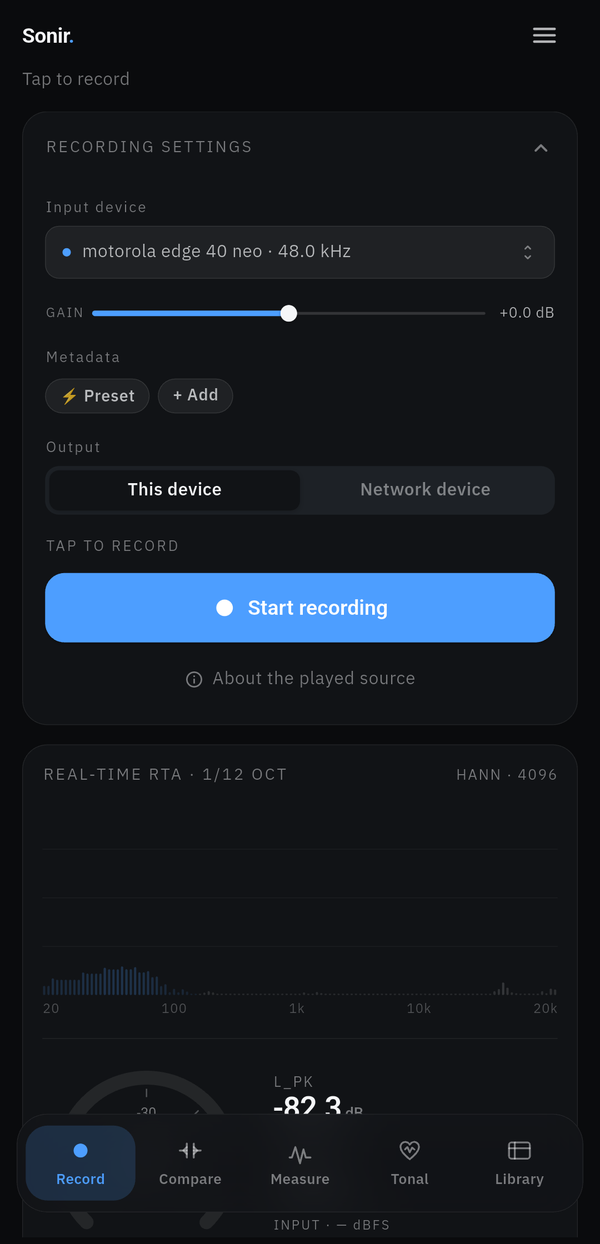
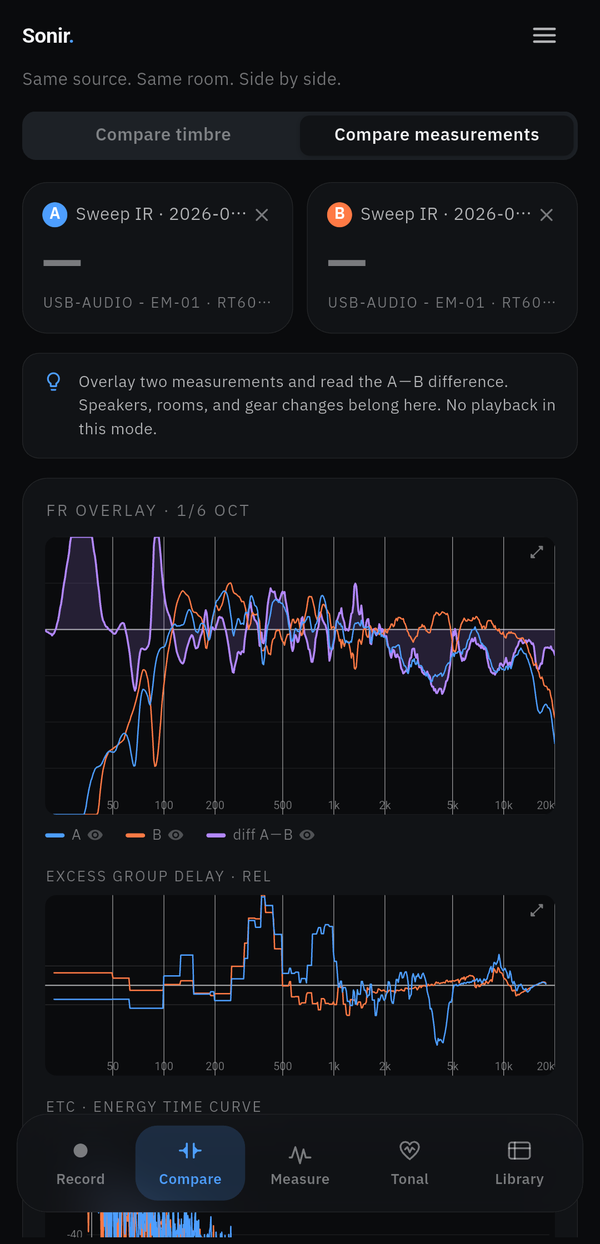
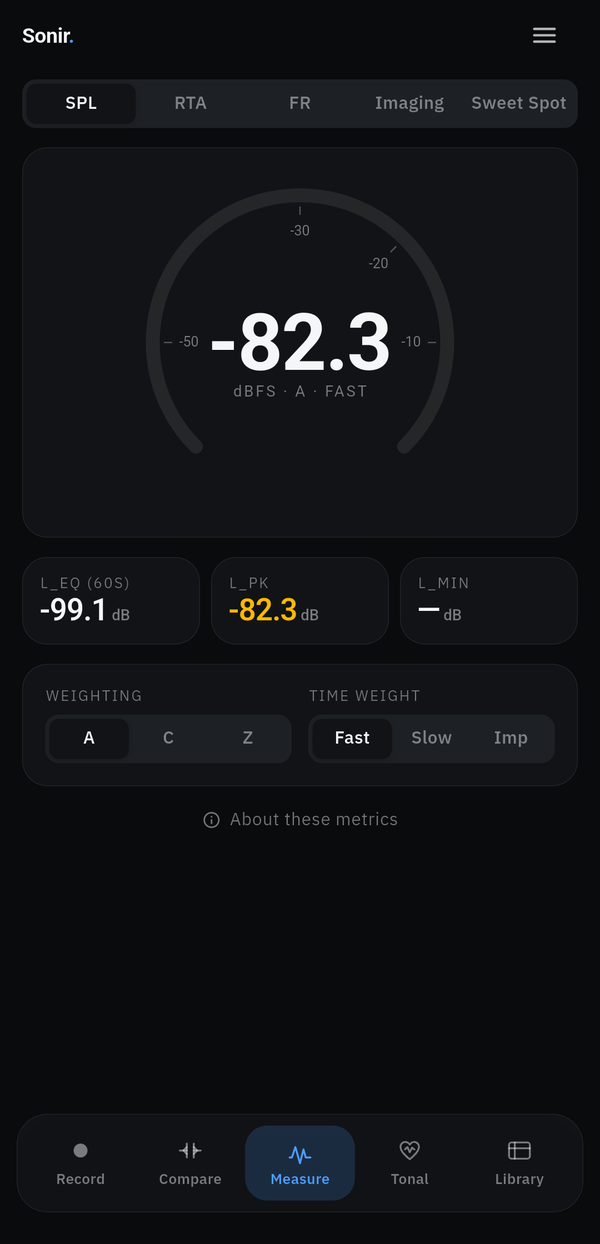
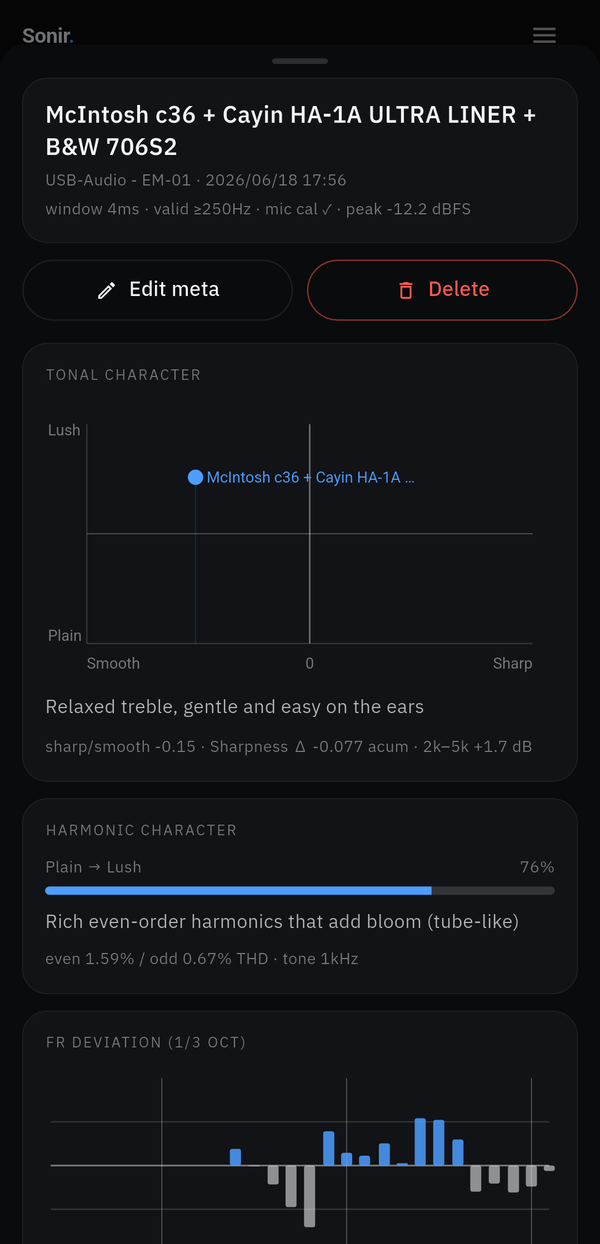
REAL APP SCREEN — SPECIMEN
STATEMENT
Measure under the same conditions.
Compare under the same conditions.
Sonir does air recording, acoustic measurement, and comparison on a single phone. It is a measurement tool for air recording and audio comparison, built for reproducibility and comparability rather than vibes.
iPhone / iPad. No server, no account required.
“It sounded great” doesn’t help you next time.
Mic position, level, room, gear. Change one condition and the recording becomes a different thing. What air recording and speaker comparison really need is not a vibe but measuring under the same conditions and lining recordings up to compare. Existing measurement apps only spit out numbers — they aren’t built to put recordings side by side. That is exactly where Sonir goes all-in.
Three pillars
Score a single take across multiple axes and turn it into a comparison card you can post straight to social. Keep the verdict as numbers and an image, and share it.
Gear profile + calibration file + room tags give you complete metadata. Any take, recorded any time, can be compared later under the same conditions.
Comparing recordings and overlaying spectra is Sonir-only among mobile apps. Line them up, switch, and confirm the difference with both ears and eyes.
Serious measurement tools, free to use.
Everything is free — core measurement, the per-band deep dives, and export. No in-app purchases, no ads. Switch tabs and take a look at the real measurement graphs.
Acoustic measurement — SPL / RTA / FFT
FreeSound level (A/C/Z weighting, Fast/Slow/Impulse), real-time analyzer, and FFT spectrum. Measure instantly with the built-in mic.
Learn more →Sweep → IR → room acoustics
FreeGenerate an impulse response from a full-band sweep. Read the time structure with ETC, then compute RT60 / EDT / C50 / D50 via Schroeder integration in one pass.
Learn more →Comparison + overlaid spectra
FreeLevel-match two recordings and switch instantly. Overlay their spectra to see the difference — a mobile-only comparison feature.
Learn more →Recording score
FreeScore a single take across four axes — clipping, noise floor, dynamic range, and frequency balance — into a share-ready comparison card.
Learn more →File inspection
FreeDerive the effective bandwidth from a track’s max-hold spectrum and flag fake-hi-res / lossy signs from mismatches with the declared sample rate.
Learn more →Measure, compare, improve, then measure again.
Comparison between recordings and a recording score. Sonir is the only phone app that does both.
| App | Comparison | Recording score | Calibration | UI |
|---|---|---|---|---|
| Decibel X | × | × | △ | Modern |
| SignalScope X | × | × | ◎ | Mixed |
| AudioTools | △ | × | ○ | Dated |
| Sonir | ◎ | ◎ unique | ○ (.txt) | Modern |
Competitor information was checked against each app’s App Store listing in July 2026. Specifications may change.
Sources: Decibel X / SignalScope X / AudioTools
Frequently asked questions
What does Sonir do? +
Sonir is a phone app for acoustic measurement (SPL / RTA / FFT, plus sweep-based impulse response for RT60, frequency response, and waterfall), air recording with a recording score, and comparison between recordings.
Is my data sent to the cloud? +
No. Sonir has no server. Recordings, measurements, and calibration files all stay on your device. Sharing happens only through generated images and the OS share sheet.
Does it support external mics and calibration files? +
It supports loading calibration files (.txt) such as UMIK. Both loading and external USB mic input are free.
Does Sonir cost anything? +
Sonir is completely free. No in-app purchases, no subscription, no ads. Everything is included: SPL, RTA/FFT, sweeps through to RT60 and frequency response, per-band analysis, comparison between recordings (measurement overlay), tonal profiling, file inspection, and export.
How is RT60 calculated? +
A log sweep recording is deconvolved into an impulse response, Schroeder backward integration builds the decay curve, and a straight line is fitted over its -5 to -25 dB span to extrapolate RT60 from T20. The IR is truncated at the noise floor before integration, so background noise is not counted as reverberation.
CLOSING
Same conditions, once more.
Now available on iOS. Start with reproducible measurements from your very first take.