
Same room, same speaker, and 48 Hz sitting +9 dB above everything else. Swapping cables didn’t move it. Swapping the speaker didn’t move it. Pulling my chair back a metre did. The culprit wasn’t gear, it was the distance between two walls.
The short answer
A standing wave is a resonance that builds up when sound bounces back and forth between two opposing walls and reinforces itself at one particular frequency. Only the room’s dimensions decide that frequency. For a wall-to-wall distance of L metres, the lowest resonance sits at 172 ÷ L Hz, with more at every whole multiple of it. At 3.6 m that’s 48 Hz, 96 Hz and 143 Hz. These resonances are what put ±10 dB peaks and dips in the low end, and they account for most of what people call the room’s character. Peaks can be cut with EQ. Dips cannot be filled.
The frequency falls out of the dimensions
Sound travels at about 343 m/s. At the frequency whose half wavelength fits exactly between the walls, the outgoing wave and the wave reflected back keep reinforcing each other at the same points. Written out, f = 343 ÷ (2L), which is 172 ÷ L. Each of the three dimensions gets its own set, so a small room of roughly 2.7 × 3.6 m with a 2.4 m ceiling looks like this.
| Dimension | 1st mode | 2nd | 3rd |
|---|---|---|---|
| 3.6 m (length) | 48 Hz | 96 Hz | 143 Hz |
| 2.7 m (width) | 64 Hz | 127 Hz | 191 Hz |
| 2.4 m (height) | 72 Hz | 143 Hz | 215 Hz |
These are the axial modes: the strongest ones, using two walls each. Suspect them first and you’ll usually be right. Tangential modes bouncing around four surfaces and oblique modes using all eight corners exist too, at lower levels. As an aside, look at the table: the third mode of 3.6 m and the second of 2.4 m both land on 143 Hz. Pile-ups like that are what make a peak tall.
Where the peaks and dips sit
A mode has a shape. Wall surfaces are always pressure antinodes, and for the first mode the node lands exactly at the centre of the room. Sit in the middle and 48 Hz drops out; move near a wall and the same 48 Hz swells. Same room, same source, and the bass changes with nothing but your seat.
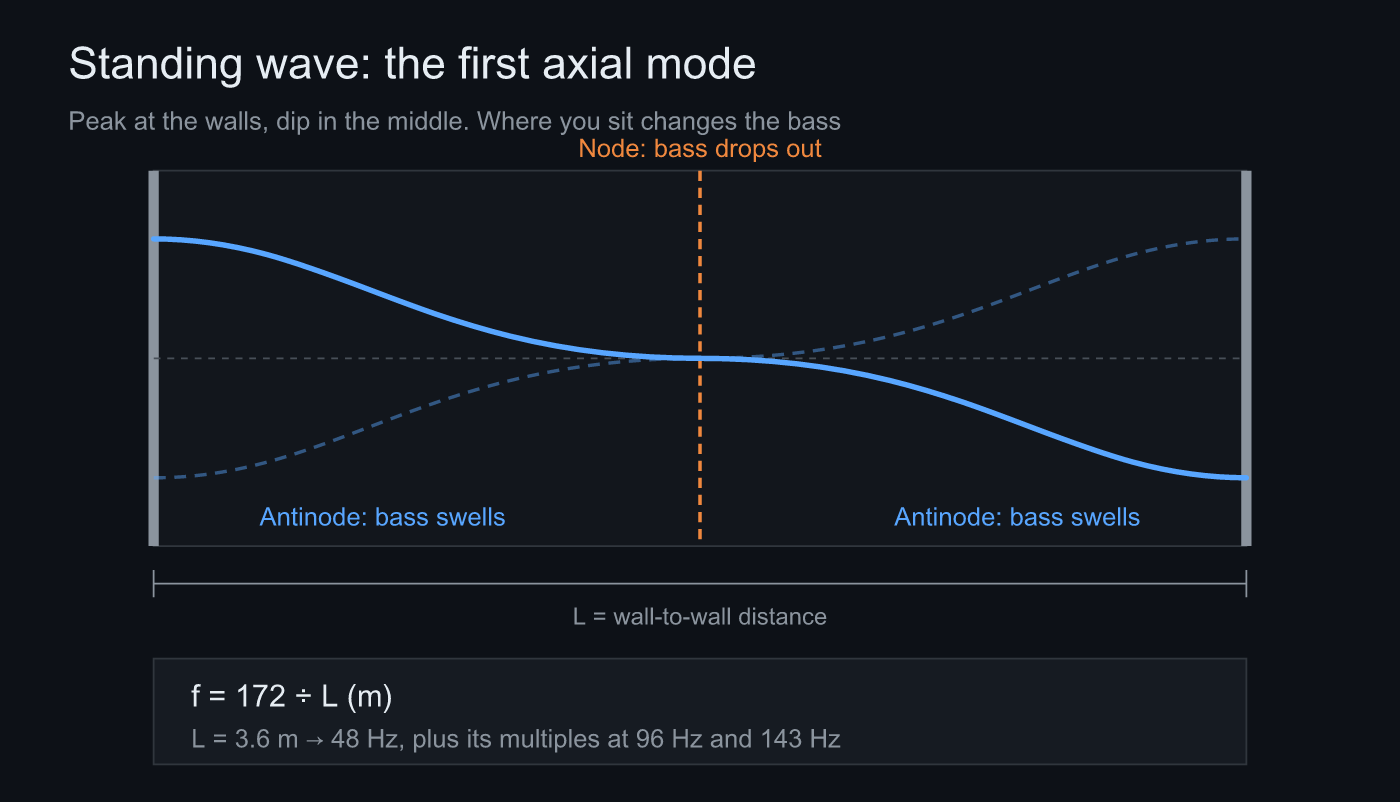 The first mode standing between two walls. Bass swells at the wall and thins out in the middle. f = 172 ÷ L (m)
What matters is that this shape is nailed to the room. Move the mic a little and a peak stays a peak. That repeatability is exactly why EQ works there: cut it in the measurement and it’s cut at your ears too. Above 300 Hz the response also swings around, but that comes from overlapping reflections, and there a 10 cm shift can trade a peak for a dip, which is why point EQ doesn’t belong. The dividing line is the Schroeder frequency, around 200–300 Hz in a typical room.
Stop trying to fill the dips
A low-frequency dip is the reflected wave cancelling the direct sound. Something cancelled by phase gets cancelled again in the same proportion when you add more of the same frequency. Push +10 dB into it and the dip stays while your amplifier and speaker lose headroom. The low end is the most power-hungry band there is, so a pointless boost down there goes straight to distortion.
Honestly, it took me half a day to accept that. Flattening the curve on screen and improving the bass in the room turned out to be two different projects. When a dip runs deep, the fix isn’t EQ: move the speaker or the listening position a few tens of centimetres. Step off the node and the dip fills itself in.
That sets the order of operations. 1. Move things → 2. Put low-frequency absorption in the corners → 3. Cut whatever peaks remain with EQ. EQ comes last, and it only ever subtracts.
How to find the standing waves in your room
- Measure all three dimensions: length, width, ceiling height in metres, then 172 ÷ distance for each. Note the doubles and triples as well.
- Sweep from the listening position: mic at ear height, recording peak inside -6 to -12 dBFS. Clip it and the frequency response goes with it.
- Match the numbers to the peaks: zoom into 20–300 Hz on Sonir’s frequency response and look for peaks near the frequencies you calculated. Within about 10% and it’s an axial mode.
- Move and measure again: shift the mic roughly 50 cm and repeat. Peaks that don’t move are standing waves. Bumps that swap around come from reflections; leave them alone.
- Cut the peaks only: Sonir’s auto PEQ works on 20–300 Hz, cutting by at most -12 dB and boosting by at most +6 dB. Leave the dips.
FAQ
Can absorption panels kill a standing wave?
No. They can shorten the decay, but low-frequency wavelengths run several metres and ordinary panel thicknesses do almost nothing down there. You need dedicated low-frequency absorption (bass traps) in the corners, and even then the resonance itself remains.
Is the middle of the room the flat spot?
It’s the opposite. The node of the first mode, where pressure is zero, sits at the centre, so bass thins out there. Right against a wall you are at an antinode and it swells instead. Both are extremes; in practice a seat set back about a third of the room dimension behaves better.
Why are square rooms considered bad?
Equal dimensions produce equal axial-mode frequencies, so several modes pile up on the same frequency. The peaks get higher and the gaps between them get emptier. The further the dimension ratios are from small whole numbers, the more the modes spread out and the gentler the response gets.
Can the maths alone tell me the standing-wave frequencies?
It gives you a working estimate for the axial modes, but reality drifts from it. Openings, wall construction, furniture and the tangential and oblique modes running diagonally all shift things. Treat the numbers as a place to start looking, then confirm the peaks with a sweep measurement.
Related reading
- Measuring frequency response and applying room EQ from a phone: the parent guide, from measurement to correction to export
- Which frequencies should you fix first with room EQ?: why only 20–300 Hz, and in what order
- Where should the mic go when measuring a room?: choosing a position that avoids nodes and antinodes
- What recording level should a measurement hit?: the detail behind step 2
Measure it with Sonir
Sonir does acoustic measurement and comparison on a phone. Run a sweep, and you can check on screen whether the peaks really land on the standing-wave frequencies you calculated. Everything is free, including the per-band deep dive.
Download on the App Store. Android is coming soon. More on the features page.