
“Same speakers, but their recording sounds better than mine.” A good share of that gap is probably not the speakers. It is the room.
The short answer
How much room lands in an air recording is set by two things: mic distance and frequency band. Record at 1 m in an ordinary room and more of the energy reaching the mic is reverberation than direct sound. Below 300 Hz the room’s standing waves swing harder than the frequency response differences between most gear. Comparison still works, not because the room is a small effect, but because a fixed setup puts the same room on both takes.
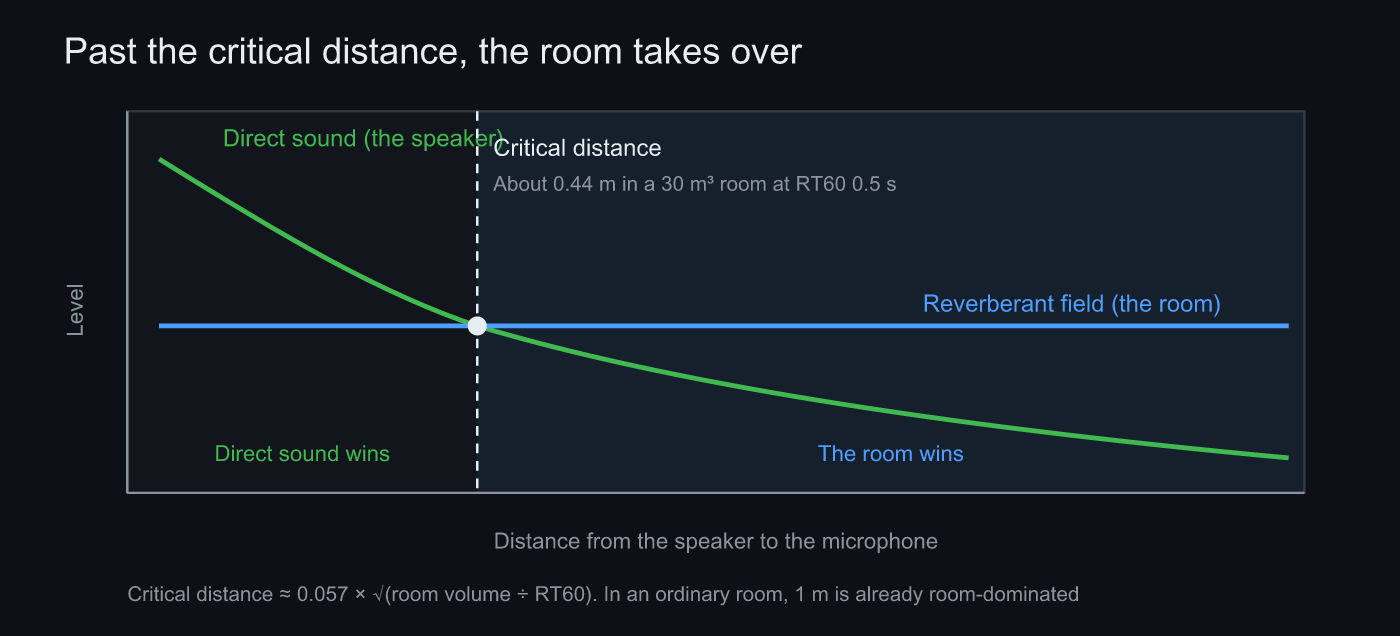 Direct sound falls with distance; the reverberant field sits at roughly the same level everywhere. The crossing point is the critical distance
Where the room starts
What reaches the microphone is the sum of the sound that came straight from the speaker and the sound that bounced off the walls and ceiling on the way. Direct sound drops about 6 dB every time the distance doubles. Reverberation fills the whole room, so it holds roughly the same level wherever you put the mic.
The distance where those two balance is the critical distance, roughly 0.057 × √(room volume ÷ RT60). In a 30 m³ room with an RT60 of 0.5 s, that is about 0.44 m.
Which means that once you are recording at 1 m across a desk, most of what you captured is the room. This is why thinking of air recording as “recording the speaker” stops adding up. What you actually have is a collaboration between the speaker and the room.
The band matters too
The second axis is frequency. The dividing line is the Schroeder frequency, roughly 2000 × √(RT60 ÷ room volume). For the same 30 m³ room at RT60 0.5 s, that is about 260 Hz.
Below it, standing waves set by the room’s dimensions stand up at discrete frequencies. Peaks and dips over 10 dB are unremarkable, and that is a larger number than the response difference between most speakers. Sonir puts the main battleground for room EQ at 20 to 300 Hz for exactly this reason: that band belongs to the room.
Above it, individual modes crowd together and the behaviour turns statistical. The room still colours the sound, but gear differences read properly. Sonir normalises the frequency response so the 300 Hz to 3 kHz average sits at 0 dB, which anchors everything to the band that can actually be read.
The room being there is not what breaks comparison
By this point air recording comparison sounds hopeless. It is the opposite.
Recorded in the same room at the same position, the room’s contribution rides on take A and take B equally. Overlay them and most of it cancels, the same way a microphone’s own character cancels. Gear differences show up in air recordings not because the room is quiet, but because the room is a shared term.
So the decisive thing is not improving the room. It is not moving it. Sonir stores the room, the equipment profiles and the distance alongside each recording so that “the same conditions as last time” is still reproducible six months later.
When the shared term breaks
The awkward part is that the room can stay the same room and still stop being a shared term.
- The speaker moved: different modes get excited by different amounts. Tens of centimetres reshape the low end
- The mic was placed again: the nodes and antinodes of standing waves are set by position, so in the same room you are now measuring a different response
- Furniture, people or doors changed: mid and high frequency absorption changes. Incidentally, there are rooms where opening a door alone moves the RT60
In practice the first two are what bite. Furniture differences usually disappear into the noise.
Pinning the room down with numbers
- Measure RT60 once: one sweep. Above 0.6 s, reverberation tends to lead.
- Get the critical distance and pick a mic distance: closer leans toward the gear, further leans toward the room. Neither is wrong.
- Lock distance, height and angle: tripod or clip, peak between -6 and -12 dBFS.
- Read 20 to 300 Hz in the frequency response: that mess is the room’s department.
- Swap only what you are testing: everything else stays put.
Honestly, you do not need to compute a critical distance to get started. Fix the mic and record from the same spot. That alone gets you ninety per cent of a valid comparison. The numbers start mattering when you want to line your recording up against someone else’s, and that one is still unsolved here: a different room means the shared term is gone, and there is no honest way to put the two on the same footing.
FAQ
How much of the room ends up in an air recording?
It depends on mic distance and frequency band. Record further away than the critical distance (about 0.44 m in a 30 m³ room at RT60 0.5 s) and more of the arriving energy is reverberation than direct sound. At a normal listening distance of 1 m or more the room is almost always dominant. In frequency, everything below the Schroeder frequency (about 260 Hz under the same conditions) is ruled by the room’s standing waves, and above it the room shows up as an average character.
Can I still compare gear when the room is all over the recording?
Yes. As long as the room, the mic position, the source and the level stay fixed, the room’s contribution rides on both takes equally, so overlaying them cancels most of it. Air recording comparison works not because the room is a small effect, but because the room is a shared term.
If I move the speakers, do I have to start over?
Yes. Moving a speaker changes which room modes it excites and by how much, so the room stops being a shared term. Low-end peaks and dips change shape over tens of centimetres. Nothing but the thing under test should move.
Is a bloated low end the gear’s fault?
Below 300 Hz, suspect the room first. Standing wave peaks and dips routinely exceed 10 dB, which is larger than the frequency response difference between most pieces of gear. Measure the swept response and you can tell whether a peak belongs to the position or the gear simply by swapping the gear and measuring again.
How do I reduce the room’s influence?
Move the mic closer to the speaker. Inside the critical distance the direct sound dominates and less reverberation gets in. Go too close, though, and driver spacing takes over and you capture something quite unlike what you hear at the listening position. For air recording it is more practical to keep the room in and keep it identical than to try to remove it.
Related
- How to record and compare air recordings under the same conditions: the parent guide, recording and comparing end to end
- Why does an air recording sound different every time?: killing the variance on the conditions side
- Measuring RT60 with a smartphone: the complete guide: turning reverberation into a number
- Measuring room acoustics with a smartphone: the whole measurement picture, response included
- Which band should room EQ fix first?: the order to correct 20 to 300 Hz in
Measure it with Sonir
Sonir does air recording, acoustic measurement and comparison on the phone. Measure RT60 and frequency response in the same app to pin the room down with numbers, then keep that room tag and your equipment profiles attached to every recording. Recording scores, tonal comparison, and overlaying measurements against each other are all free.
Download on the App Store. Android is coming soon. More on the features page.