
I swapped a DAC and thought the soundstage opened up and the bass tightened. What actually changed was the output level, by 0.8 dB. Matched, the difference disappeared. That was the day half a notebook of listening notes went in the bin.
The short answer
An A/B comparison with unmatched levels compares levels, not gear. Listeners notice differences as small as 0.2 to 0.3 dB when switching directly, and at 1 dB they consistently describe the louder side as having “more bass” and “more resolution”. Loudness matching is therefore a precondition, not a refinement, and it has to be done on K-weighted integrated loudness (LUFS) rather than peak values. Target: within ±0.1 dB.
How louder turns into better
Raise the level and the ear’s own frequency sensitivity shifts. As the equal-loudness contours show, the sensitivity to low and high frequencies rises relative to the midrange as sound pressure goes up. So the same track played 1 dB louder sounds like it has more bass and more treble extension. The frequency response hasn’t moved a hair.
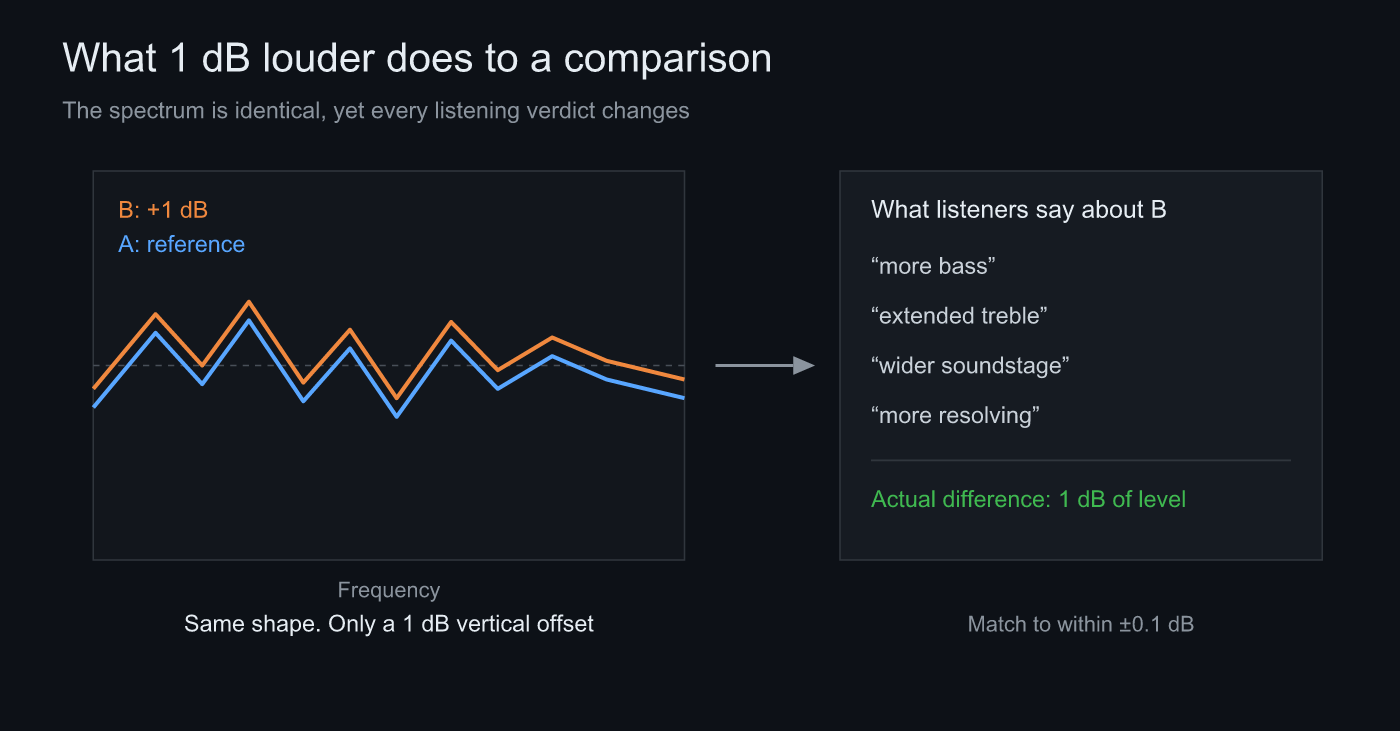 Same shape, shifted 1 dB vertically. It still turns into “more bass” and “wider soundstage”
The awkward part is that the effect arrives without any sense of “that’s louder”. One decibel is too small to register as a level change. It never registers as one, and surfaces in consciousness as better sound quality instead. That’s misattribution, and willpower doesn’t defend against it. When a hi-fi demo runs at unmatched levels, deliberately or not, the listener’s conclusion is already decided.
As an aside, this isn’t an argument for distrusting your ears. The ears detect the difference correctly. It’s the brain that files the cause under sound quality instead of level. Which means confidence that you personally aren’t fooled by a level difference is exactly the condition for being fooled by one.
What to match on: peak, RMS or LUFS
There are three yardsticks. In order of trustworthiness: LUFS, RMS, peak.
| Yardstick | What it reads | Usable for A/B matching |
|---|---|---|
| Peak (dBFS) | The single loudest instant | No. Heavily compressed material ends up clearly louder |
| RMS | Average energy over a window | Workable. Loose when the spectral balance differs a lot |
| Integrated loudness (LUFS) | K-weighted average | The standard. ITU-R BS.1770, closest to perception |
Peak fails because the loudest instant and the average level don’t track each other. A heavily compressed track has a high average and a low peak; a dynamic one is the other way round. Match those by peak and the compressed one sits several dB louder. It happens constantly.
K-weighting means rolling off the low end and lifting above 2 kHz a little, shaped after human sensitivity. That’s what lets you match material with different spectral balance to the same perceived level. It’s also where RMS falls short on EQ on/off comparisons: lift only the bass and RMS jumps, while perceived loudness moves much less.
The procedure
- Make LUFS the yardstick: decide up front that you match on integrated loudness, not on fader marks or visible peaks.
- Read both integrated loudness values: analyse the files in Sonir’s inspection tab and you get integrated loudness, DR and true peak. The LUFS difference is the gain to remove.
- Turn the louder one down: pushing the quiet side up can drive true peak past 0 dBTP and distort. Aim for ±0.1 dB.
- Switch within a few seconds: the longer the gap, the more auditory memory decays, and anything subtler than level stops being decidable.
- Escalate to measurement: if the difference evaporates the moment levels match, level was the difference. Measure the frequency response and read the difference curve.
Moving to measurement makes the problem disappear
Honestly, listening-based A/B stays uncertain even when the level matching is done properly. Match to ±0.1 dB and you still have switching memory, order effects and expectation bias sitting there.
Measurement changes the premise. Sonir’s frequency response is a relative curve normalized to 0 dB in the midrange, so a few dB of playback level leaves the peaks and dips where they are. A failure of level matching can’t contaminate the conclusion. What does bite instead is clipping: a measurement whose recording pinned at full scale collapses in shape. Aim for -6 to -12 dBFS.
That’s why Sonir pushes comparison toward measurement. Not to dismiss listening: there are things only listening resolves. But if the claim is about gear performance, it’s faster to settle it on ground that level can’t contaminate. How far to automate matching on the air-recording side is still undecided.
FAQ
How small a level difference starts to skew the verdict?
In direct switching, differences of 0.2 to 0.3 dB are reported to have an effect, and at 1 dB the louder side is preferred almost consistently. That’s why comparison listening aims to match within ±0.1 dB. Half a decibel isn’t a rounding error, it’s enough to flip a conclusion.
Can’t I just match the peak values?
No. Peak only reports the single loudest instant, which has little to do with how loud something sounds on average. Match a heavily compressed track against a dynamic one by peak and the compressed one will clearly sound louder. RMS, which averages, is usable; LUFS, which averages with perceptual weighting, is better.
Does EQ on/off need matching too?
It needs it more than most. EQ adds or removes energy in a band, so loudness almost always changes. Lift the bass by +3 dB and the whole thing sounds louder, mixing the effect of the EQ with a plain level increase. RMS isn’t enough here; use LUFS.
What about comparing measurements, does level matter there?
Barely. Sonir’s frequency response is a relative curve normalized to 0 dB in the midrange, so a few dB of playback level leaves the peaks and dips exactly where they are. What does bite is clipping: a recording pinned at 0 dBFS collapses the curve. Aim for -6 to -12 dBFS.
Related reading
- How to record and compare air recordings under the same conditions: the parent guide, and the idea of same-condition capture itself
- How do you A/B two speakers fairly?: matching position, stimulus and level in practice
- What dBFS should a measurement recording peak at?: clipping and signal-to-noise in detail
- How to spot fake hi-res files: reading what’s actually inside a file in the inspection tab
Measure it with Sonir
Sonir does acoustic measurement and comparison on a phone. Read integrated loudness, DR and true peak in the inspection tab and you have the gain difference between two files on the spot. Everything is free, including the per-band deep dive.
Download on the App Store. Android is coming soon. More on the features page.