
I swapped speaker A for speaker B, measured again, and the bass came up 3 dB. What raised it was not the speaker. It was the mic I had nudged 10 cm while swapping.
The short answer
A speaker A/B is fair only when nothing except the speaker moved. Three things have to stay identical: mic position, the stimulus you measure with, and playback level, in that order of impact. Then compare measurements rather than listening impressions, and read the difference curve (A−B) to see where and by how much they differ. Speakers are close to impossible to judge fairly by ear, so Sonir routes the comparison into measurement.
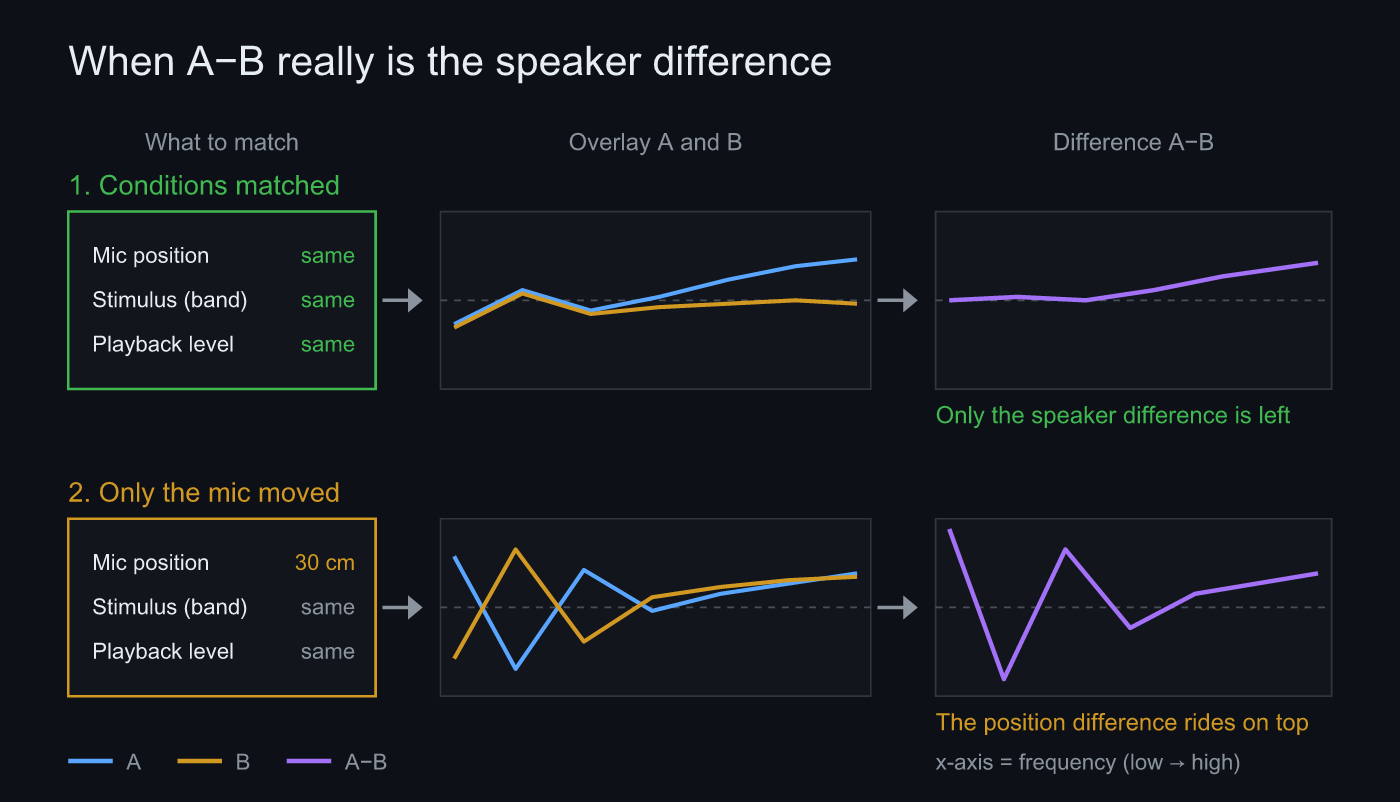 Match the conditions and the difference is the speaker. Move the mic and the position difference rides along with it
Why “nothing except the speaker”
The difference curve A−B contains the sum of everything that changed between A and B. If you meant to change only the speaker but also moved the mic, the position difference is in there too. In the bass it is often the larger of the two.
A 100 Hz tone has a wavelength of about 3.4 m. Standing-wave nodes and antinodes sit a quarter of that apart, roughly 85 cm. Move the mic 30 cm and you can cross from the dip side to the peak side. That was the 3 dB in the opening. I had half a day of measurements lined up and was about to conclude “B has more bass” before the position log made me throw all of it out.
The mic’s own coloration, on the other hand, is harmless as long as the position is fixed. Measure with the same mic in the same place and its signature lands equally on the A curve and the B curve, so it cancels the moment you take the difference. That is why an A/B holds up even without a calibration mic (Can you trust frequency response without a calibration mic?).
Level matching matters for listening, not for measuring
“Level matching first” is the standard advice for A/B, and it is right, but it is right about listening. People consistently hear the slightly louder side as better and more accurate, which makes it the biggest confound in any by-ear comparison. Target ±0.1 dB; ±0.5 dB is too loose to help.
For a measurement comparison the constraint loosens. Sonir’s frequency response is a relative curve normalized to 0 dB in the midrange, so a few dB of playback level leaves the peaks and dips where they are. What actually bites is clipping: if one side pins, that curve collapses in shape. That is the reason for keeping the recording peak between -6 and -12 dBFS (What dBFS should a measurement recording peak at?).
Incidentally, we built a blind ABX for speakers once and then took it out. A single-mic air recording drops imaging, soundstage, and distortion, so concluding “which one is better” from playing that recording back was never going to hold.
The steps
- Fix the mic and never touch it again: put it at the listening position, lock it to a stand or tripod, and leave it there through the swap.
- Measure both with the same stimulus: same sweep, same band. Different bands misalign the axes and the difference stops describing the gear.
- Set the level just short of clipping: recording peak between -6 and -12 dBFS. Throw away and redo any take that pinned.
- Overlay them and read the difference curve: load both into the A/B slots and treat A−B as the main line. RT60, EDT, C50 and D50 line up with deltas.
- Re-measure when a mismatch warning appears: mic calibration, stimulus band, and room mismatches raise a banner. You can continue, just do not conclude from it.
What you cannot match, you write down
In practice you never match everything. Different cabinet sizes put the tweeter at a different height, and swapping shifts the speaker a few centimetres. Honestly this part is unresolved: I have no swap procedure that lets me say “same position” and mean it.
What Sonir does instead is refuse to erase the parts that did not match. Mic profile, stimulus band, room, distance, gear. Those get compared before the overlay, and a mismatch raises a warning. It does not block. A comparison under imperfect conditions is still worth reading, so you can continue, as long as there is enough of a record left to explain the difference afterwards.
FAQ
Is it wrong to pick speakers by listening?
Choosing what you like is your call, but listening is a poor route to a verdict. A single-mic air recording throws away imaging, soundstage, and distortion, so playing it back only carries the coarse tonal difference. That is why Sonir dropped blind ABX and moved speaker comparison onto the measurement overlay.
How precisely does the level have to match?
Aim for ±0.1 dB if you are judging by ear. People consistently rate the slightly louder side as better, and ±0.5 dB is far too loose. For a measurement comparison the constraint relaxes: frequency response is a relative curve normalized to 0 dB in the midrange, so a few dB of playback level does not change the shape. What matters there is clipping.
How far can I move the mic?
You do not. Bass is strongly position-dependent because of room modes: at 100 Hz (wavelength about 3.4 m) the nodes and antinodes sit roughly 85 cm apart. Moving 30 cm can carry you from a dip to a peak, and that shift is often larger than the real difference between the two speakers.
Should the speakers sit in the same spot too?
As a rule, yes: swap them into the same position. Placement changes how the room modes are excited, so different positions mean you are measuring the setup, not the speakers. When cabinet sizes make an exact match impossible, record the distance and a note and discount the difference accordingly.
Can I compare two measurements taken on different days?
Yes, if the conditions line up. Noise floor and room temperature shift over time, so confirm both were measured with the same mic profile, the same room, and the same distance. Sonir keeps mic, stimulus, room, and distance as metadata and warns you about mismatches before it overlays.
Related reading
- How to record and compare air recordings under the same conditions: the parent guide, and the idea of same-condition capture itself
- Can you trust frequency response without a calibration mic?: why the mic’s coloration cancels when the position is fixed
- Measure room acoustics with a smartphone: what a sweep to impulse response actually gives you
Measure it with Sonir
Sonir handles acoustic measurement and comparison entirely on your phone. The A/B in this article is exactly what it does: run a sweep on each speaker, overlay the two measurements, and read the difference curve and the metric deltas. Everything is free, including overlaying measurements against each other.
Download on the App Store. Android coming soon. See the features page.