
Judge a room by RT60 alone and it will occasionally disagree with your ears. Two rooms can both sit at 0.4 s, and one sounds articulate while the other smears. EDT and C50 are what catch that difference.
The short answer
RT60 is the slope of the decay as a whole, EDT the slope of the first 10 dB, and C50 / C80 the ratio of early energy to late. For how long a room rings, read RT60 and EDT. For how clear it is, read C50 (speech) or C80 (music).
What each one measures
One line each.
| Metric | What it tells you | Fitted over | Unit |
|---|---|---|---|
| RT60 | length of the reverberation | slope from -5 to -25 dB, extrapolated to 60 dB (T20) | s |
| EDT | perceived reverberance | slope from 0 to -10 dB, extrapolated to 60 dB | s |
| C50 | speech clarity | energy in 0–50 ms vs. everything after | dB |
| C80 | musical clarity | energy in 0–80 ms vs. everything after | dB |
| D50 | share of early energy | 0–50 ms ÷ total | 0 to 1 |
RT60 and EDT look at different stretches of the same decay curve. C50 and C80 cut the time axis into early and late and take an energy ratio. The only thing separating them is where the cut falls, 50 ms or 80 ms.
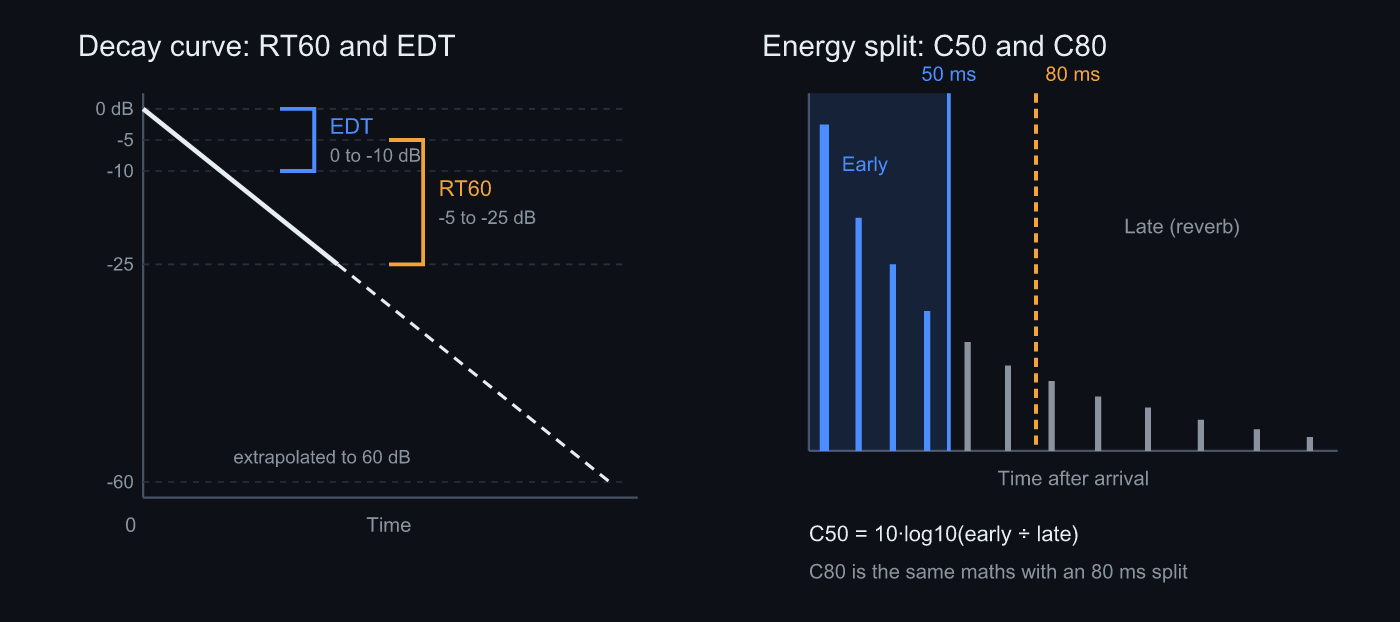 Left: RT60 fits -5 to -25 dB, EDT fits 0 to -10 dB. Right: C50 and C80 compare energy either side of the split
What it means when RT60 and EDT disagree
This is the part that earns its keep.
If a decay were perfectly linear, EDT and RT60 would land on the same number. Real rooms don’t. The 0 to -10 dB stretch EDT uses contains only the direct sound and the early reflections, so EDT measures how the very first moment falls away. The -5 to -25 dB stretch RT60 uses sits further along, where the whole room is ringing.
So a room whose EDT is shorter than its RT60 has strong early reflections and a fast initial fall. It can measure long on paper and still sound tight. The opposite case, EDT longer than RT60, means the initial decay is sluggish: absorption is unevenly distributed and energy lingers right behind the direct sound.
But when EDT overshoots RT60 by a lot, suspect the measurement before the room. Integrate past the noise floor and noise energy accumulates in the reverberant tail, flattening the slope. That failure shows up in EDT first. Sonir estimates where the decay hits the noise floor and excludes everything beyond it from every metric, but if the SNR was poor to begin with, that truncation estimate degrades too. EDT ≫ RT60 means checking your recording’s SNR first.
C50 and D50 are one number in two costumes
C50 states the ratio in dB, D50 states it as a fraction. Written out: C50 = 10·log10(D50 ÷ (1 − D50)). When D50 is 0.5, half the energy inside the first 50 ms, C50 is exactly 0 dB. Read whichever you prefer; the other follows.
Higher C50 means early energy dominates and speech is easier to follow. Move further from the source and late energy grows, so C50 drops. It shifts when you change seats in the same room, which makes it a sharper instrument than RT60 for positional questions.
What Sonir gives you, and what it doesn’t
Being straight about it: the metrics Sonir derives automatically from the IR are RT60, EDT, C50 and D50. C80 is not computed. For music-oriented clarity work that’s a gap, and it’s still an open one.
What did get the attention instead is the reliability side. RT60 (T20) needs about 25 dB of usable decay range and EDT about 10 dB, and that condition is checked rather than assumed. The per-octave analysis (63 / 125 / 250 / 500 / 1k / 2k / 4k / 8k Hz, following ISO 3382) additionally tests the linearity of the regression and the in-band SNR, and reports how many bands came out untrustworthy. Being able to say a number is broken felt more useful than shipping one more number.
How to read them in order
- Record the sweep. Peak at -6 to -12 dBFS.
- Check the usable decay range: about 25 dB for RT60, about 10 dB for EDT.
- Compare RT60 and EDT. Shorter EDT means strong early reflections; a much longer one means look at your SNR.
- Read C50 (or D50). In a speech-heavy room this is what you’ll feel.
An aside: with four metrics on screen, the one I actually check most is still the RT60-to-EDT ratio. Nobody hears the difference between 0.42 s and 0.38 s, but an EDT sitting at 1.5× the RT60 is audible.
FAQ
What’s the difference between EDT and RT60?
The interval they fit. RT60 extrapolates the slope between -5 and -25 dB out to 60 dB (T20); EDT extrapolates the slope over the first 0 to -10 dB. EDT is sensitive to early reflections and tracks the reverberance you actually hear.
Should I look at C50 or C80?
C50 (a 50 ms split) is the usual choice for speech and dialogue, C80 (an 80 ms split) for musical clarity. Only the split time differs; both are the ratio of early energy to late energy.
Does Sonir report C80?
No. What it derives automatically from the IR is RT60, EDT, C50 and D50. C80 isn’t computed, so if you need a music-oriented clarity figure, export the IR and calculate it elsewhere.
My EDT came out far longer than RT60. Is the room bad?
Usually it’s the measurement, not the room. Integrating below the noise floor piles noise onto the reverberant tail and stretches EDT. Check whether your SNR is sufficient and whether you can use a longer sweep.
Do I need to read D50 and C50 separately?
No. They’re the same quantity on different scales: C50 = 10·log10(D50 ÷ (1 − D50)). When D50 is 0.5, meaning half the energy lands within 50 ms, C50 is exactly 0 dB.
Related reading
- Measuring RT60 with a smartphone: the complete guide: the parent guide, from definition to the mechanism that breaks the number
- Why is my RT60 absurdly long?: clipping and SNR, the same root cause that breaks EDT
- How much RT60 is good for a listening room?: targets by use and the spread across bands
- Measuring room acoustics with a smartphone: the wider map of what’s measurable
Measure it with Sonir
Sonir is an app that closes the loop on acoustic measurement and comparison on a phone. The EDT and C50 in this article too: play the sweep, record it, and RT60, EDT, C50, D50 and the waterfall come out of the IR automatically. Everything is free, including the per-octave depth.
Download on the App Store. Android coming soon. More on the features page.