
“Is my room’s RT60 a good value?” It’s a question that’s hard to answer with a single number, but there are targets, and the ways people miss are clear.
The short answer
A good RT60 for a listening room is roughly 0.3 to 0.5 s in the mid-band. Larger rooms hold up at the longer end. But instead of chasing “what’s the right number,” it pays more to watch whether only the lows drag on, the band-to-band spread.
Why one number doesn’t settle it
RT60 is a time figure derived from the slope of the decay, and the optimum moves with room volume, use, and taste. A larger room sounds richer at the same number of seconds, and if you listen nearfield up close, shorter is easier to handle. On top of that, ears are more sensitive to bass that drags than to the length of the mids: a broadband average of 0.4 s still sounds like a “boomy room” if 125 Hz alone sits at 0.9 s. So before the seconds, look at which band is dragging.
Targets by use
Here’s a rough set of targets referenced to the mid-band (500 Hz to 1 kHz), as a table and a chart. The optimum shifts with room volume, so take it as a range, not a pinpoint number.
| Use | RT60 target (mid-band) | Symptom when too long |
|---|---|---|
| Recording / vocal booth | 0.2–0.3 s | the room’s tail bleeds into the take |
| Home theater | 0.3–0.4 s | dialogue gets unclear |
| Listening room | 0.3–0.5 s | bass goes boomy and drags |
| Untreated living room | 0.5–0.8 s | flutter and booming show up easily |
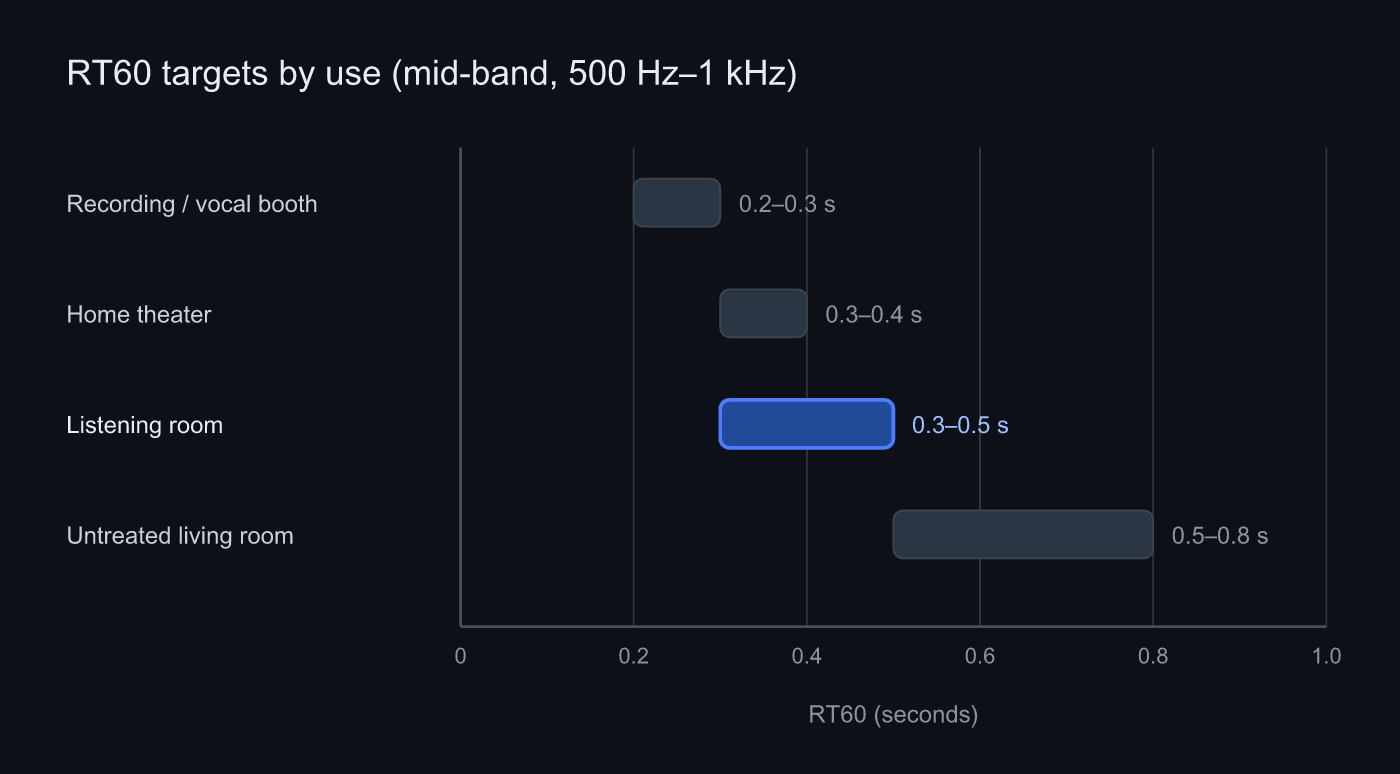 RT60 targets by use. A listening room sits at 0.3–0.5 s mid-band. Larger rooms lean to the upper end; a mostly nearfield setup is easier toward the lower end
Symptoms of too long / too short
Often it’s more practical to spot it by symptom than to memorize numbers.
A room that’s too long (above ~0.6 s for listening) gets boomy in the bass, drags a tail, and smears the imaging. Turn up the volume and it sounds saturated, with fine detail buried under the trailing reverb. A room that’s too short (below ~0.2 s), on the other hand, is dead: the sound thins out and the space feels cramped. Gear character struggles to come through, and you get the unnatural feel of listening in an anechoic chamber.
The sweet spot has a clean decay and an RT60 that doesn’t split wildly from lows to highs. Even when the seconds land inside the range, if the bass alone spikes the perception tips toward “too long.”
Read it by band, not by one number
Here’s the real point. The bass drags from room modes, while the mids and highs get absorbed shorter by furniture and curtains. So the ideal is an RT60 that stays smooth across the bands.
As a rule of thumb, if the bass (63 to 125 Hz) drags past 1.2 to 1.5x the mids, suspect the lows first. Sonir splits RT60 into ISO 3382 octave bands (63 / 125 / 250 / 500 / 1k / 2k / 4k / 8k Hz) so you can see it. A broadband number can read 0.4 s while one split band is a different animal, because the average hides the bass tail.
How to judge your own room
- Look at the broadband RT60 in the mid-band (500 Hz to 1 kHz) and place it in the table above.
- Split it into octave bands and check whether only the lows spike.
- If they do, look at absorption or room EQ for the lows first (20 to 300 Hz). Don’t EQ up the dips.
Having measured a few rooms, my take is that lining up the bands changes the sound more than chasing the seconds to two decimals. Whether it’s 0.45 or 0.5 s, your ears can barely tell, but a bass band sitting 1.5x long is obvious in one listen.
FAQ
What’s the ideal RT60 for a listening room?
Roughly 0.3 to 0.5 s in the mid-band (500 Hz to 1 kHz). Larger rooms can carry the longer end. But rather than chase an absolute number, watch whether only the lows drag on, which is the band-to-band spread.
Is a shorter RT60 always better?
No. A room that’s too short sounds dead and thin, and the space feels cramped. Going well below 0.2 s is unnatural. The good state is a decay that’s neither too long nor too short, and even across the bands.
Why is RT60 long only in the bass?
Room modes (standing waves). Low frequencies have long wavelengths that absorbers struggle to tame, so they drag on. A broadband average of 0.4 s often hides a single band, say 125 Hz, sitting at 0.9 s.
I measured 0.8 s. What should I do?
That’s a common value for an untreated living room. Tighten it with absorption (rugs, curtains, bookshelves) and bass treatment in the 20 to 300 Hz range. First measure by band to see which band is dragging.
Related articles
- How to measure RT60 with a smartphone: a full guide: the parent guide. RT60’s definition, how it’s computed, and the mechanism that breaks it
- How to measure RT60 with a smartphone: the hands-on recording level and SNR steps before you read a value
- Measuring room acoustics with a smartphone: a full guide: the wider map of what you can measure, RT60 included
- Feature details: sweep → IR through to RT60, per-band, and waterfall
Measure it in Sonir
Sonir is an app that completes acoustic measurement and comparison on your smartphone. The per-band RT60 in this article too: just play the sweep and record, and it derives RT60, EDT, C50, and waterfall from the IR automatically. Everything is free, including the per-octave-band deep dives.
Download on the App Store. Android coming soon. See the features page.