
A quiet acoustic track came back inconclusive. Nothing was wrong with the file: there simply was no readable energy above 2 kHz. Inspection is decided less by the label than by how you read the numbers behind it.
The short answer
The order is fixed. Declared sample rate, effective bandwidth, roll-off. Narrowing down in that order also explains why the same spectrum can produce different verdicts. The verdict comes with a confidence value, so no single track settles it.
Why the order matters
The declared sample rate comes first because it switches the yardstick.
Above 50 kHz, so 88.2 kHz and up, the hi-res yardstick applies. The question is whether the content stays inside CD territory, that is, whether the effective bandwidth reaches 26 kHz. If it does not, the file is suspected of upsampling, and confidence rises the further it sits below that line.
At 44.1 kHz or 48 kHz the container is honest, so a different yardstick applies. Here the search is for traces of a lossy origin. The bandwidth has to be narrower than 86 percent of Nyquist and the fall has to be steeper than 48 dB/oct. Both, or no verdict. Narrow alone means nothing, because plenty of recordings simply have no high-frequency content and fade out gently.
So the same spectrum ending at 22 kHz is suspicious under a 96 kHz claim and perfectly normal under a 44.1 kHz one. What gets measured is not the content but the mismatch between content and claim.
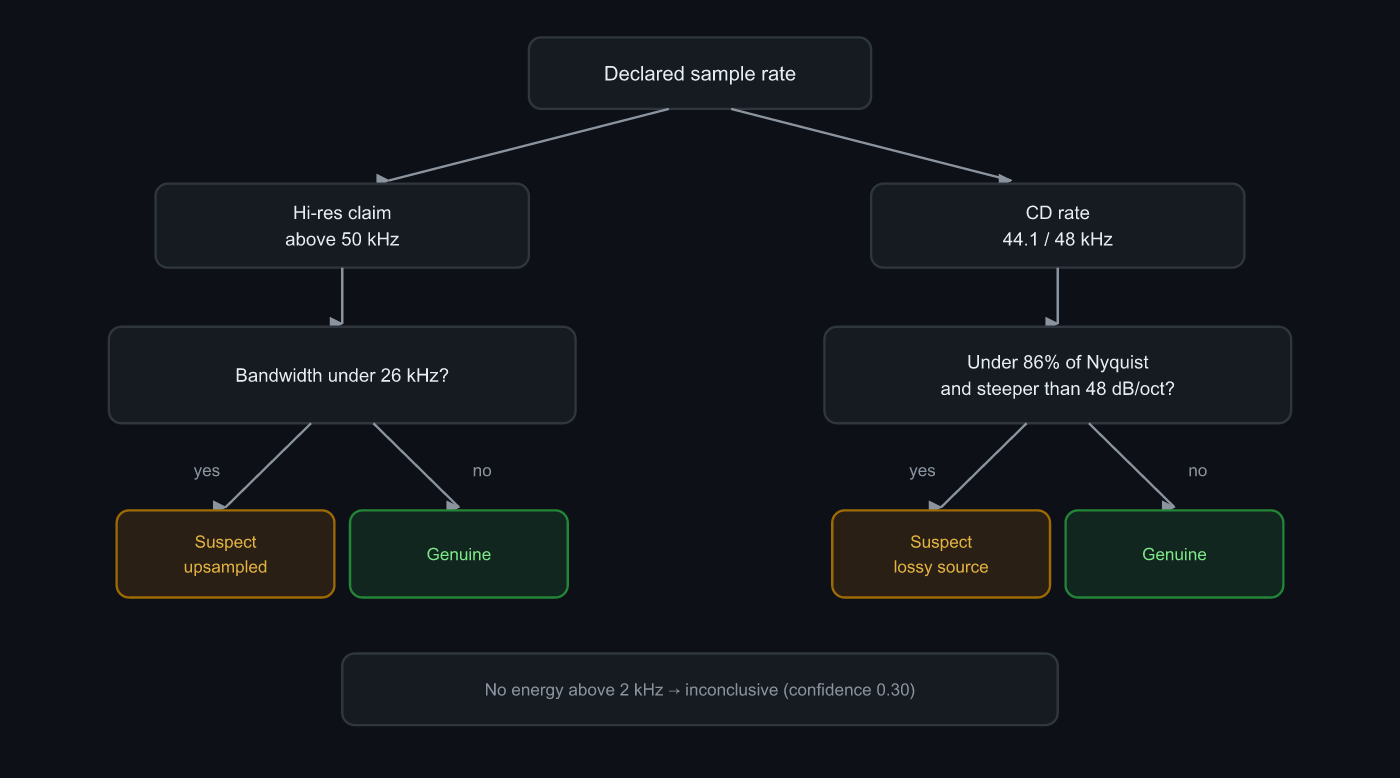 The claim splits the yardstick; bandwidth and roll-off settle the verdict. With no high-frequency energy at all, it stops earlier at inconclusive
The steps
- Let the declared rate pick the yardstick: above 50 kHz is a hi-res claim, 44.1 or 48 kHz is CD territory.
- Read the effective bandwidth: the highest frequency above -60 dB from the peak. For a hi-res claim, 26 kHz is the line.
- For CD rates, look at the roll-off: under 86 percent of Nyquist and steeper than 48 dB/oct means lossy.
- Read the confidence: suspicion verdicts start at 0.5, inconclusive is fixed at 0.30, around 0.6 is borderline.
- Cross-check another track: the same fall at the same frequency across an album is processing, not material.
No microphone takes part in inspection. The room and the speakers are out of the path, so the same file yields the same numbers on anyone’s device. That is what makes step five practical rather than theoretical.
Where correct numbers still miss
The roll-off measurement takes a shortcut. It compares the level at the effective bandwidth with the level one octave above it and reports the difference as dB/oct. When the cutoff sits high enough that the octave above runs past the analysed range, the difference comes out small. A steep wall can end up with a modest number attached to it.
There is a second one. Dither and noise shaping lift the high-frequency floor, and a lifted floor reads as extended bandwidth. The upper limit measures high while what is being measured is noise rather than material. Thresholds alone do not separate those cases, and the thresholds themselves are still being tuned against real files.
FAQ
What does an inconclusive verdict mean?
No bin above 2 kHz stayed above -60 dB from the peak. Near-silent passages or very quiet recordings leave nothing to work with, and the analysis says so instead of guessing. It does not mean the file is fake. Confidence is fixed at 0.30 in that case.
Why can the same 22 kHz limit get two different verdicts?
Because the declared sample rate changes the yardstick. A file claiming 96 kHz that stops at 22 kHz points to upsampling, but a 44.1 kHz file has Nyquist at 22.05 kHz, so reaching that far is exactly right. Same content, different meaning, because the container claims something different.
Does the analysis use the whole file?
Up to the first 90 seconds. It takes an 8192-point spectrum per segment and keeps the maximum at each frequency rather than averaging. Averaging a whole track would make a quiet piece look like it had been cut off.
How high does confidence have to be before I trust it?
There is no hard line. Around 0.9 means the bandwidth sits far from the threshold; around 0.6 means it sits near the boundary. Read the effective bandwidth and roll-off alongside the label, and when the file is borderline, try another track.
Related reading
- How to spot fake hi-res audio in the spectrum: the background to the verdicts, and why only the container grows
- Measuring room acoustics with a smartphone: the microphone side of measurement
- Acoustic measurement apps compared: choosing on the measurement side
Inspect it in Sonir
Sonir completes recording, acoustic measurement, and comparison on your phone. The verdict described here comes out automatically. No microphone is involved: pick a file from the device and effective bandwidth, roll-off, and confidence line up on one screen. The inspection tab is free.
Download on the App Store. Android coming soon. See the features page.