
A single clap will record the room ringing. But the moment you want RT60 or frequency response as numbers, a sweep and a clap give you values of different certainty. Where the gap opens up comes down to two things: SNR and dynamic range.
The short answer
For numbers you can trust, a sweep is more accurate. Three reasons: you can gain as much SNR as you want from the sweep length, you can push energy evenly down to 20 Hz, and harmonic distortion separates out of the IR. A clap wins on convenience, no gear and done in an instant, which makes it fine for a quick survey of how long a room rings. But writing that number down as an RT60 value is premature.
Why the sweep wins
A clap is a single impulse. Its energy is fixed in that instant, and trying to add more by clapping harder just clips the recording. So its SNR has a ceiling. Worse, that energy skews toward the mids and highs, leaving the low end weak, exactly where room modes misbehave. And the waveform differs every time you clap, so repeatability is poor too.
A sweep (ESS, an exponential/log sweep) is the opposite. You play the same signal over tens of seconds and convolve the recording with an inverse filter to fold it back into an IR. Because the energy is spread out over time, it does not sink into the noise after correlation. Double the length and you gain roughly +3 dB of S/N. This is the lever that matters. When SNR is short, you make the sweep longer instead of turning up the volume, widening dynamic range without inviting a clip.
There is one more property: in an ESS, harmonic distortion separates out ahead of the main IR on the time axis. Even if the speaker distorts a little, that distortion never mixes into the RT60 or frequency response. A clap has no such separation.
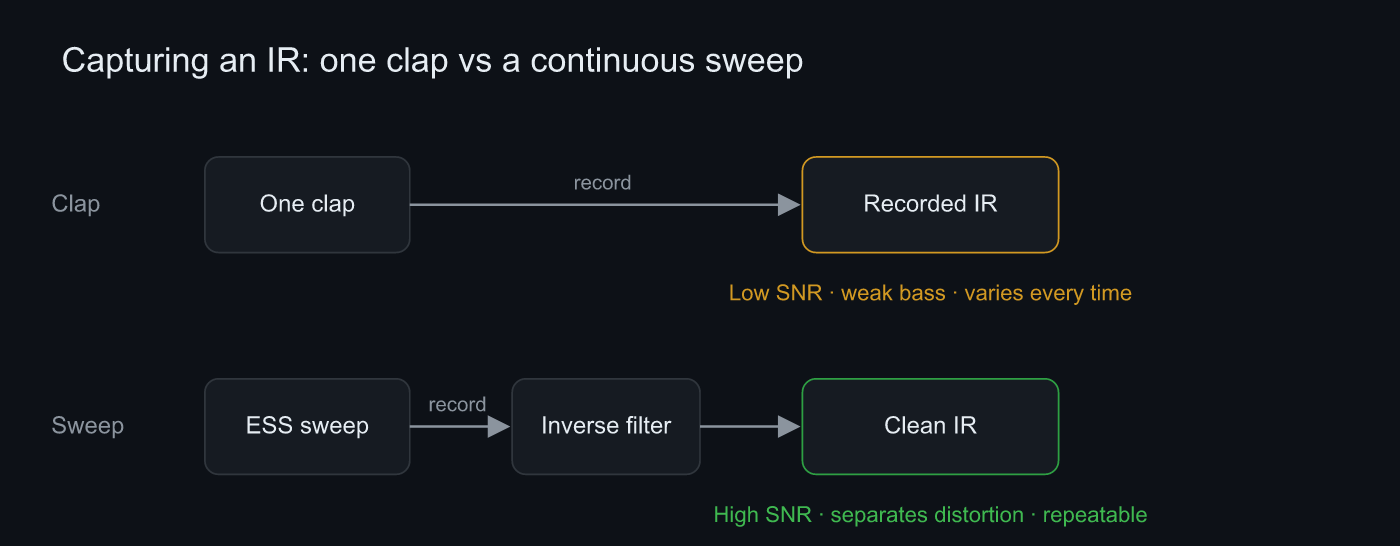 With a clap, the one shot you record is the IR as-is. A sweep runs through an inverse filter first, yielding a clean IR with noise and distortion suppressed
Sweep vs clap, side by side
| Aspect | Sweep (ESS) | Clap |
|---|---|---|
| Gaining SNR | Rises with length (≈ +3 dB per doubling) | Fixed per shot; clips if you hit harder |
| Low-end coverage | Even down to 20 Hz | Weak |
| Harmonic distortion | Separated out of the IR | Cannot be separated |
| Repeatability | Same signal = identical each time | Changes with every clap |
| Gear needed | A playback source (speaker) | Just your hands |
| Speed | Tens of seconds | Instant |
| Best for | Nailing down RT60 / frequency response | A rough survey of how long it rings |
When a clap earns its place
It is not worthless. No playback source on hand, or you just want to know in an instant whether a room rings long or short, and a clap is fast. In a large space it is enough to feel by ear whether the tail drags on. Bigger impulse sources, a popped balloon or a starter pistol, put out more energy than a clap, and they still see use outdoors and in churches. But the single-shot limit and the tendency to clip are unchanged. Indoors, when it has to become a number, that is where you re-record with a sweep.
How to capture an accurate sweep
Four steps to a clean IR, using Sonir’s sweep measurement as the example.
- Fix the phone at the measurement position: mount it on a tripod or stand at the listening position. Avoid handheld. Movement and handling noise on the head of the IR wreck everything downstream.
- Set the input peak to -6 to -12 dBFS: play the sweep, watch the level meter, and lower the volume until the peak sits in that band. Clipping is the number-one cause of a broken IR.
- Make the sweep longer to gain SNR: cover the missing S/N with sweep length, not volume. Long at the right level beats short and loud.
- Build the IR and check the decay curve: Sonir convolves the inverse filter to extract the IR and runs Schroeder integration for RT60. A straight decay means it worked; a crushed, flattened head is the sign of a clip.
FAQ
Can I measure RT60 with a clap?
You can get a rough sense of how long the room rings, but the numbers are not trustworthy. A clap has weak low end and you cannot raise its SNR, so the low-frequency RT60 in particular is unreliable. Re-record with a sweep if you want a number to keep.
How long should the sweep be?
It depends on the room and the background noise. Longer buys more SNR. When unsure, start long and shorten until the value starts to scatter. As a rule of thumb, doubling the length gains about +3 dB of SNR.
Is a balloon pop or starter pistol more accurate than a clap?
The energy per shot is larger than a clap, but it is still a single shot whose SNR you cannot raise afterwards, and it clips just as easily. They are used outdoors and in large spaces, but a sweep is steadier for nailing down numbers indoors.
Why do a clap and a sweep give different RT60 in the same room?
A clap has weak low-frequency energy and low SNR, so the low-end decay curve sinks into noise and the value tends to read long. A sweep covers down to 20 Hz evenly with high SNR, so that is the reference.
Related articles
- Measuring room acoustics with a smartphone: a full guide: the parent guide. The full picture of what sweep → IR can measure
- How to measure RT60 with a smartphone: the level and SNR practice for recording a sweep accurately
- How to measure RT60 with a smartphone: a full guide: RT60’s definition and the mechanism that clipping breaks
Measure it in Sonir
Sonir is an app that completes acoustic measurement and comparison on your smartphone. The sweep measurement in this article too: just play the sweep and record, and it convolves the inverse filter to extract the IR and derives RT60, frequency response, and waterfall automatically. Everything is free, including the per-band deep dives.
Download on the App Store. Android coming soon. See the features page.